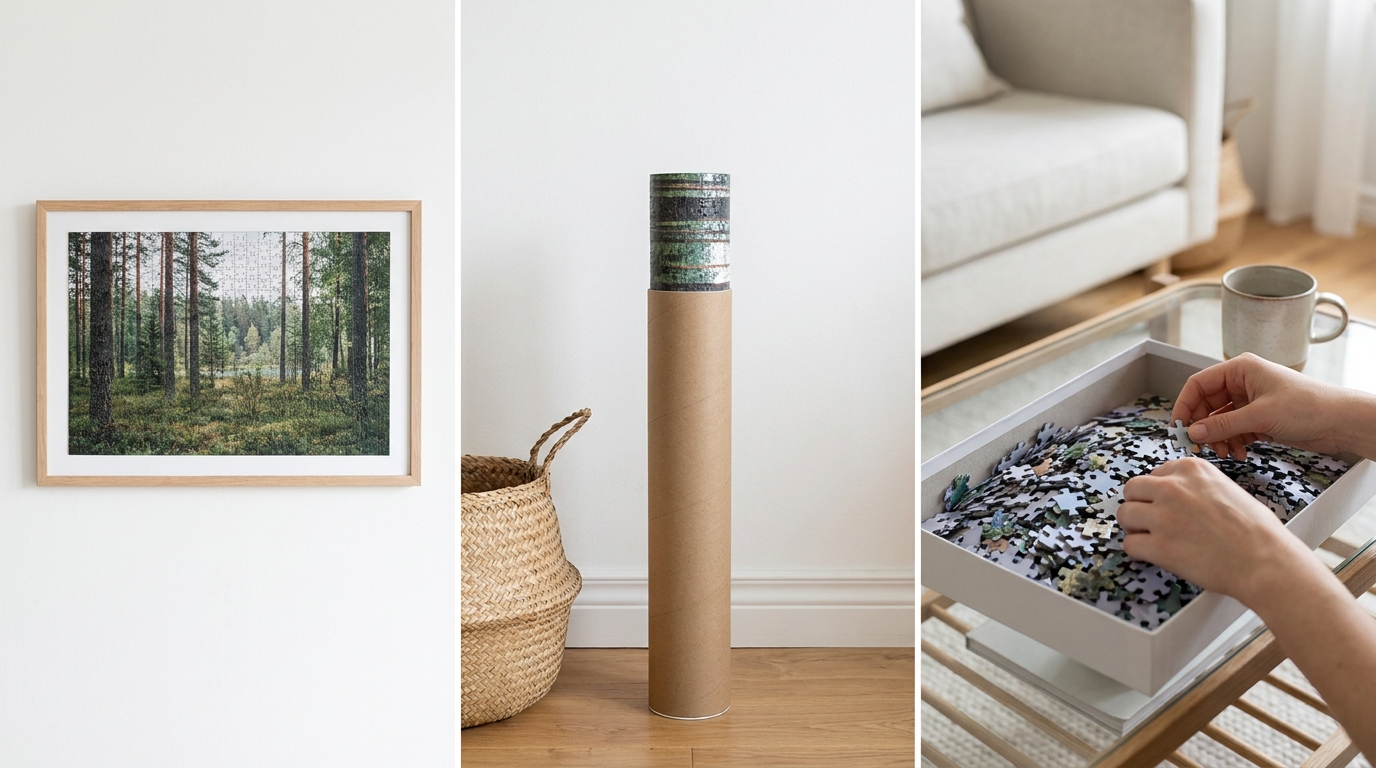
There is a specific dead moment after the last piece goes in, when the puzzle stops being an activity and becomes an object occupying your dining table. Here are the actual options.
Break it up and put it away
The default, and there is nothing wrong with it. Most puzzles are worth doing twice if you leave enough time between — six months is usually long enough to have forgotten the layout.
Store it in the original box, flat, not on its end. Puzzles stored upright shed pieces into the corners of the box and the lid stops closing properly.
Keep it and do it again soon
If several people in the house want a go, slide it onto a puzzle mat or a sheet of hardboard and put it under a bed. Do not try to move an unglued puzzle by lifting it; slide the whole board.
Frame it
For puzzles worth looking at daily. This means gluing it first, mounting it and finding a frame with enough depth — the full method is in how to frame a jigsaw puzzle.
Be realistic about which ones deserve this. Framing costs roughly what the puzzle cost, so it is generally reserved for personal images rather than commercial designs.
Glue it without framing
A glued puzzle can be leant on a shelf, hung with adhesive strips, or used as a placemat if you seal it properly. See how to glue a jigsaw puzzle.
Give it away
Charity shops take puzzles, with one condition: tape the box shut and write on it whether the count is confirmed. A puzzle donated with an unverified count is a small cruelty. Count it as you break it up.
Puzzle swaps, libraries, care homes and community centres all take them too, and generally welcome them more than charity shops do.
When a piece is missing
First, check the usual places: under the table, in the box's corner folds, under the sofa cushions, and inside the vacuum cleaner if it has been run since you started.
If it is genuinely gone, you have three options. Some manufacturers will replace a single piece if you contact them with the product code — Ravensburger among them. You can make a replacement by tracing the gap onto card, cutting it out and colouring it. Or you can accept it: a 999-piece puzzle with one hole is still a completed puzzle, and framing it under glazing hides the gap better than you would expect.
The version of this problem you can avoid
Almost all of the above is about scarcity — one physical copy, one chance to get it right. That changes if the puzzle was made from your own photo, because the image stays on file. You can glue one, frame it, and order another from the same photo without losing anything. A missing piece stops being permanent.
Read next
- Where to Donate Jigsaw Puzzles (And When Not To)Charity shops, libraries, care homes, and freecycle: where finished or unused puzzles actually get used — plus the missing-piece rule that keeps donations useful.
- How to Store Jigsaw Puzzles (In Progress and Finished)Bags, boards, roll-up mats, and shelves: a practical system for unfinished tables and finished collections — including when digital play is the smarter storage.
- How to Preserve a Jigsaw Puzzle So It Lasts on the WallPreserve means more than glue: drying, sealing, UV, and framing choices that keep a finished jigsaw flat and fade-resistant — especially photo puzzles worth keeping.