How Jigsaw Puzzles Are Made, From Map to Die Press
Who invented the jigsaw puzzle, and how a modern one is actually manufactured — lamination, steel-rule dies, and why every piece in a box has a slightly differe
Puzzlvent Editorial · 3 min read · Published August 3, 2026
A London mapmaker, 1766
The jigsaw puzzle was invented by John Spilsbury, a London engraver and mapmaker, in about
- He mounted a map of the world onto a sheet of mahogany and cut around the national borders
with a fine saw. He called them "dissected maps" and sold them to teach children geography.
They were cut with a marquetry saw, not a jigsaw — the jigsaw as a tool did not exist yet. The name attached itself much later, and stuck to a product it never actually described.
Wood remained standard for over a century. Cardboard arrived in the late 1800s and made puzzles cheap enough to be a mass product, which is why the Great Depression turned them into a genuine craze: a cardboard puzzle was hours of entertainment for pennies, and could be passed round a street.
How a modern puzzle is manufactured
1 · The image is printed. Onto a large sheet of paper, usually on an offset litho press for long runs or a high-quality digital press for short ones. Personalised puzzles are digital by definition — every one is a run of one.
2 · It is laminated to board. The printed sheet is bonded to greyboard, typically 1.5–2 mm. This is the step that determines quality more than any other. Poor adhesion is why cheap puzzles delaminate — the picture layer lifts away from the board at the edges.
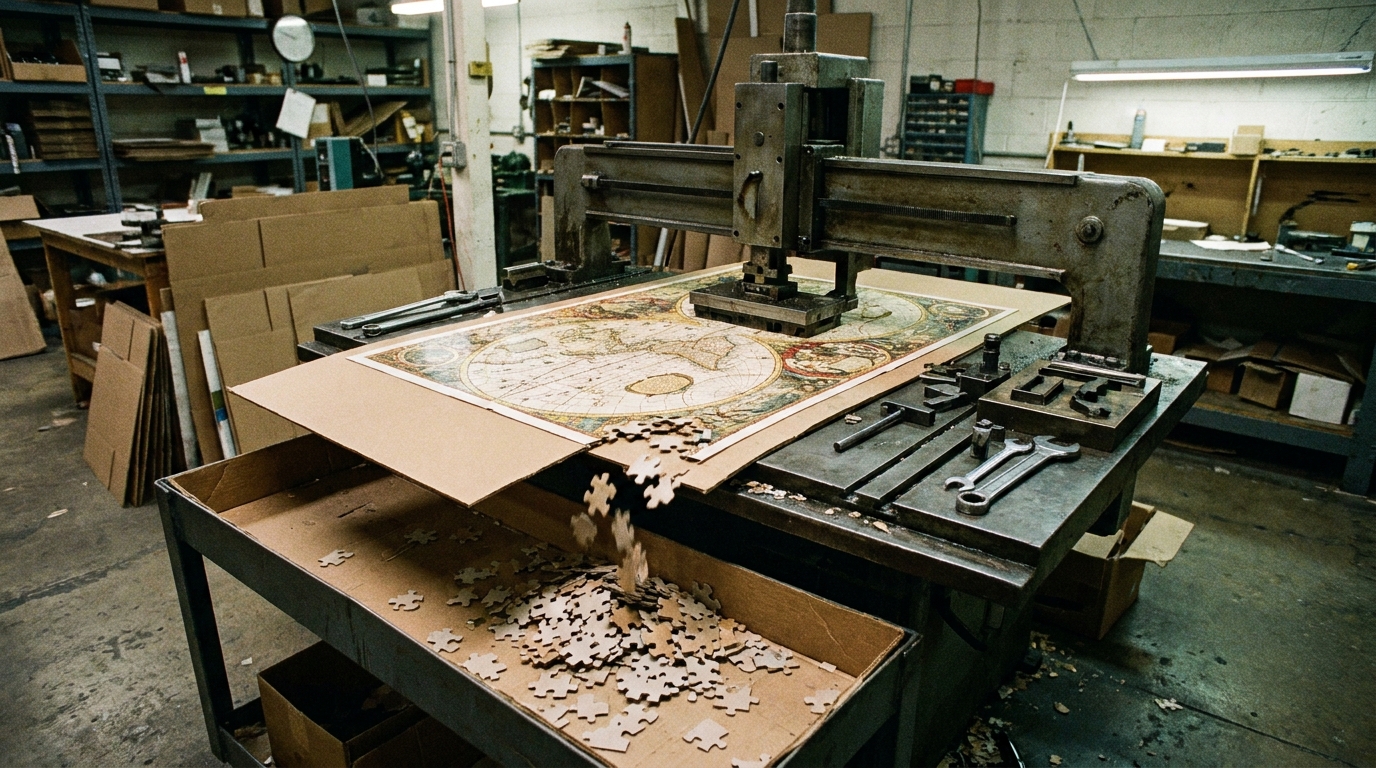
3 · A die is made. This is the expensive part. Thin strips of sharpened steel are bent by hand into the puzzle-piece pattern and set into a plywood base, like an enormous, extremely intricate pastry cutter. A single die costs thousands and cuts hundreds of thousands of puzzles.
4 · It is pressed. The laminated sheet goes under the die in a hydraulic press at up to 500 tonnes. One stroke cuts the whole puzzle at once.
5 · It is broken, checked and boxed. The cut sheet is flexed to separate the pieces, weighed to confirm the count, and boxed.
Why every piece is a different shape
A steel-rule die is bent by hand, so no two segments of the pattern are truly identical. That is why the pieces in a good puzzle have subtly different shapes and why two pieces that are not neighbours will not click together convincingly. Cheaper puzzles use a repeating grid pattern, and you can feel the difference immediately: wrong pieces fit, and the puzzle stops being satisfying.
What changes for a personalised puzzle
Everything except the die. The image is yours, printed digitally, laminated and pressed with the same steel-rule die as any other puzzle in that piece count. The one extra step is a print-quality check before manufacture — we will not press an image that falls below 150 DPI at the size you picked, because the pieces would show visible softness at the cut edges. You can upload a photo and see which sizes it supports before ordering anything.
Read next
- Photo Collage Gift Ideas, and How to Make One That Is Not a MessCollages fail for predictable reasons: too many photos, no hierarchy, and a print size that turns faces into thumbnails. How to build one that works, and what t
- Where to Donate Jigsaw Puzzles (And When Not To)Charity shops, libraries, care homes, and freecycle: where finished or unused puzzles actually get used — plus the missing-piece rule that keeps donations useful.
- Missing Jigsaw Puzzle Piece: What to Do When One Is GoneSearch the house methodically, then decide: manufacturer replacement, custom piece, recycle, or start again with a photo puzzle you control end to end.