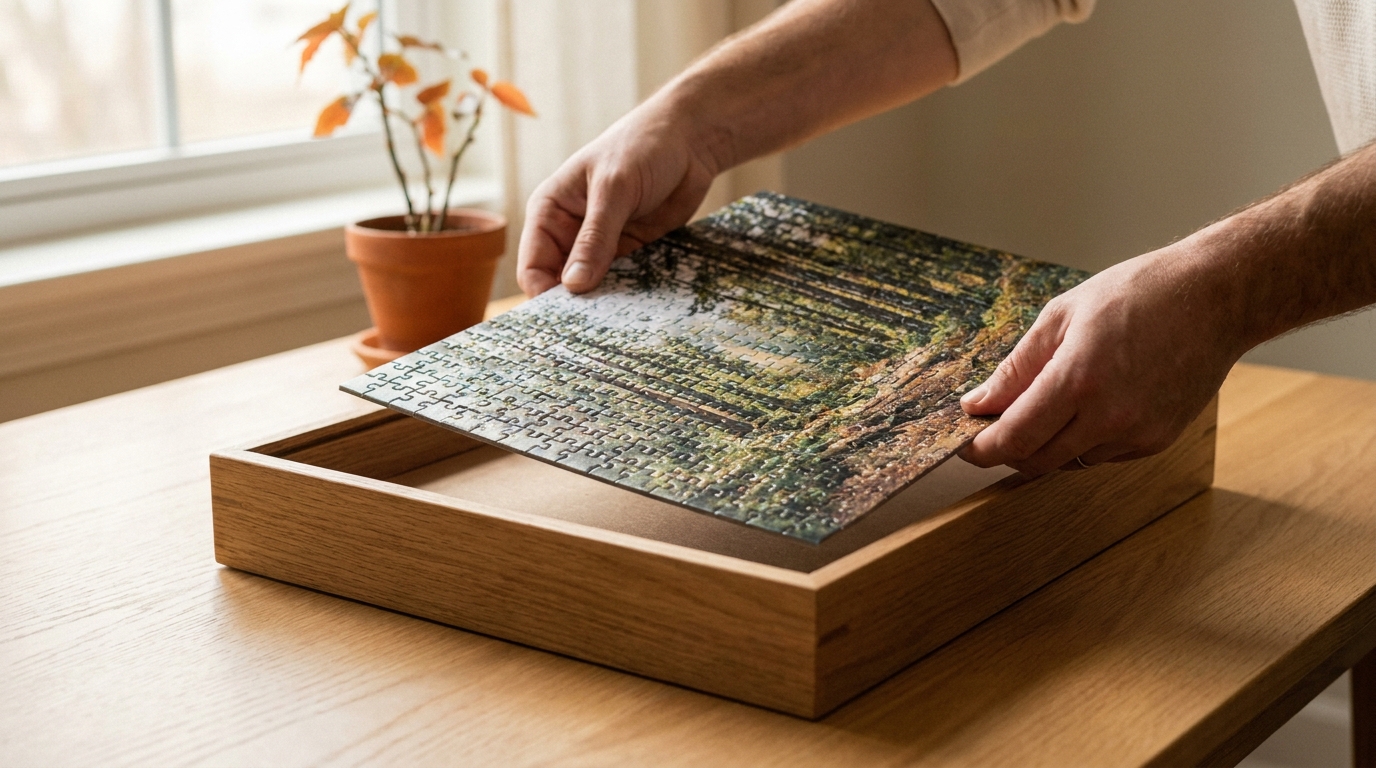
You finished it, and now it is occupying the dining table indefinitely. Framing is the way out — but a jigsaw is thicker than a photograph, and a frame chosen for a print will not close over one.
Work out the finished size first
Measure the assembled puzzle before you buy anything. Piece counts are not standardised across manufacturers, so a "500 piece" puzzle from one maker will not match another. Our own 500-piece board finishes at 480 × 340 mm, which sits close to A2 but is not A2 — near enough to be frustrating if you order a frame on the assumption.
Measure the depth too. A glued puzzle on a backing board is usually 4–6 mm thick, which rules out most standard photo frames.
Glue it before you move it
Do not try to lift an unglued puzzle into a frame. Apply puzzle glue or a thin PVA across the face, let it dry completely, and only then handle it as a single sheet. The full method is in our guide to gluing a finished jigsaw puzzle.
Mount it on something rigid
Glue alone does not stop a large puzzle sagging. Mount the dried sheet onto foam board or hardboard cut to the exact finished size, using spray adhesive applied to the board rather than to the puzzle. Work from the centre outwards to push air to the edges.
Choose the frame
Three things matter:
- Rebate depth. You need at least 8 mm to take the puzzle, the mount board and the glazing. A
box frame is the reliable choice.
- Glazing. Acrylic is lighter and safer than glass for anything above 500 pieces, and it will
not shear if the frame is knocked off a wall.
- UV protection. Direct sunlight will fade a printed puzzle within a couple of years. If it is
going on a bright wall, UV-filtering acrylic is worth the difference.
If it has already warped
Puzzles cup when one side absorbs moisture. Lay the puzzle face-down on a flat surface, cover it with a damp — not wet — cloth for an hour, then press it flat under books for 24 hours before gluing. It will not fix severe warping, but it recovers a gentle curve.
A note on which puzzles are worth framing
Framing is roughly the cost of the puzzle again, so it tends to be reserved for the ones that mean something. That is usually a photograph rather than a stock landscape — which is the whole reason people order a personalised photo jigsaw puzzle in the first place. If you are planning to frame it from the start, order the largest piece count your photo can carry: more pieces means a larger finished print, and a wall wants size.
Read next
- Where to Donate Jigsaw Puzzles (And When Not To)Charity shops, libraries, care homes, and freecycle: where finished or unused puzzles actually get used — plus the missing-piece rule that keeps donations useful.
- How to Store Jigsaw Puzzles (In Progress and Finished)Bags, boards, roll-up mats, and shelves: a practical system for unfinished tables and finished collections — including when digital play is the smarter storage.
- How to Preserve a Jigsaw Puzzle So It Lasts on the WallPreserve means more than glue: drying, sealing, UV, and framing choices that keep a finished jigsaw flat and fade-resistant — especially photo puzzles worth keeping.